A ring can be decoration. A pendant can be a private declaration. The difference often lies in occult jewelry meaning: the layer of intention, history, and identity carried by a symbol close to the body. For some wearers, it is a reminder of protection or spiritual discipline. For others, it signals independence, secret knowledge, artistic rebellion, or membership in a tradition that refuses easy explanations.
The symbol itself is only part of the message. Who wears it, why they chose it, where it appears, and how they treat it all shape its meaning. Jewelry does not grant status, wealth, authority, or supernatural control on its own. Yet symbols can focus attention, strengthen a personal ritual, and make an inner commitment visible. That is where their real force begins.
Occult Jewelry Meaning Is Never One-Dimensional
People often search for a single, fixed definition of an occult symbol. They want to know whether a pentagram is evil, whether an eye means secret power, or whether a skull is a warning. The honest answer is more demanding: context rules.
A symbol may have religious, magical, political, artistic, and commercial histories at the same time. A five-pointed star, for example, has appeared in ancient art, ceremonial magic, folk protection traditions, modern Pagan practice, and fashion. The direction of the point, the surrounding design, and the wearer’s intent can change the message considerably.
This is why serious collectors look beyond dramatic internet claims. They ask where a design came from, how it was used, and whether the maker understands the tradition being referenced. Mystery is part of occult aesthetics, but confusion is not wisdom.
Intention gives the piece a personal charge
A necklace worn after a meditation practice may become a cue to stay calm under pressure. A signet ring inherited from a family member may represent loyalty, memory, or responsibility. A black stone set in silver may be selected because its dark, restrained appearance gives the wearer confidence in a demanding room.
None of this requires blind belief. Human beings use objects to mark transitions, promises, grief, devotion, and ambition. Occult jewelry makes that practice more explicit. It says that the visible life and the hidden life are connected.
The Symbols Most People Recognize
Certain motifs appear again and again because they speak to enduring human concerns: protection, knowledge, mortality, transformation, and the desire to see beyond appearances.
The all-seeing eye
The eye is commonly associated with vigilance, perception, divine witness, and hidden knowledge. It can suggest that nothing is entirely concealed, including the motives people hide from themselves. In modern culture, the eye also attracts conspiracy interpretations connected to elite institutions and secret societies.
That association can be part of the appeal, especially for someone who wants jewelry that feels forbidden or intellectually provocative. Still, the eye has a much wider history than any one organization. Treat it as a symbol of awareness before treating it as proof of a hidden allegiance.
The pentagram and pentacle
A pentagram is a five-pointed star. A pentacle is often a pentagram enclosed in a circle, though usage differs between traditions. Many practitioners view the five points as expressions of the elements: earth, air, fire, water, and spirit. The circle can represent unity, boundaries, or wholeness.
For many contemporary Pagans and witches, this is a sacred emblem of balance and protection. For others, it is an aesthetic statement. An inverted pentagram may carry different meanings depending on the group or design, so do not assume that every version announces the same belief.
The moon, triple moon, and celestial forms
Moon jewelry speaks to cycles, intuition, change, and the passage from darkness into light. The triple moon is frequently associated with phases of life and feminine spiritual traditions, although wearers may interpret it in their own way. Sun, stars, planets, and eclipses add a cosmic scale, suggesting that personal choices take place within larger rhythms.
These pieces work especially well for people who want occult style without an overtly confrontational symbol. A subtle lunar pendant can carry a private meaning while remaining elegant in a professional setting.
The serpent, skull, and raven
The serpent is one of the oldest mystical images. It can signify wisdom, healing, temptation, renewal, or the shedding of an old identity. Skulls confront mortality, but they can also express courage, memento mori philosophy, and the refusal to fear the inevitable. Ravens often point toward intelligence, prophecy, transformation, and the threshold between known and unknown.
These symbols have sharper visual energy than a simple star or moon. They suit wearers who want their jewelry to create a reaction, not merely complement an outfit.
Sigils, seals, and sacred geometry
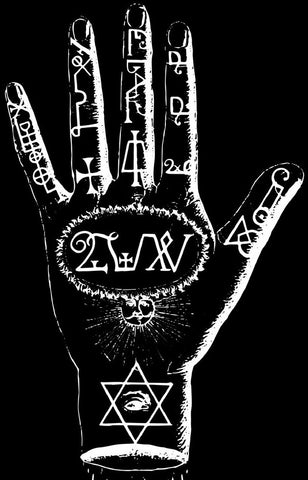
A sigil is a mark created or adopted to represent an intention, spirit, concept, or hidden name. Seals may come from historical grimoires, ceremonial systems, or modern occult art. Sacred geometry uses repeating forms such as circles, triangles, hexagrams, and interlocking patterns to express order within apparent chaos.
This category deserves care. A symbol copied from a book, tattooed on a ring, or sold without context may be visually striking but disconnected from its original use. If you are drawn to sigils, learn their source and decide whether you want historical accuracy, personal symbolism, or simply an evocative design.
Wearing Occult Symbols With Discernment
Occult jewelry can invite conversation, admiration, suspicion, or misunderstanding. That is not always a reason to hide it. It is a reason to choose deliberately.
If you work in a conservative office, a small talisman tucked beneath a shirt may serve you better than a large ceremonial pendant. If you are a musician, performer, or visual artist, a bold symbol can become part of your public image. The right choice depends on whether you want privacy, recognition, provocation, or a daily anchor.
Material matters as well. Silver is often linked with the moon, reflection, and restraint. Gold suggests solar presence, achievement, and visibility. Iron has strong folk associations with boundaries and defense. Stones bring their own symbolic language, though their meanings vary widely between cultures and modern spiritual communities.
Do not confuse price with power. A costly piece may be beautifully made and durable enough to become an heirloom, but a simple pendant can hold deeper personal value if it marks a sincere decision or practice. The object becomes meaningful through relationship, not through a seller’s promise.
How to Choose a Piece That Feels True
Begin with the question beneath the purchase: what are you trying to remember, protect, express, or become? The answer may be ambition, spiritual curiosity, grief, creative confidence, discipline, or a desire to step outside ordinary expectations.
Then research the symbol before you wear it publicly. Learn enough to explain it without repeating rumors. Avoid designs that borrow sacred imagery from living traditions carelessly, particularly if you have no connection to that practice. Respect creates more depth than imitation ever can.
Finally, give the piece a place in your life. You might wear it only during study, keep it near a journal, use it as a prompt before an important performance, or put it on when you need to act with more intention. A private ritual can be as simple as pausing for one clear breath and naming the quality you want to carry forward.
The Hidden Message Is the One You Live
Occult jewelry often attracts people because it promises a language beyond ordinary words. That longing is real. We all want signs that our lives have direction, that our choices matter, and that we are not limited to the role others assigned us.
But a symbol becomes convincing only when your actions support it. A ring associated with authority means little if you avoid responsibility. A pendant associated with abundance cannot replace skill, patience, or honest work. A talisman of insight asks you to observe more carefully, not to abandon judgment.
Choose the symbol that challenges you as much as it flatters you. Wear it with knowledge, keep its meaning personal when privacy serves you, and let it remind you that the most guarded chamber is the one where intention becomes action.